
Central Asia’s Rail Freight Market Is Emerging from Stagnation: The Market Begins to Revive
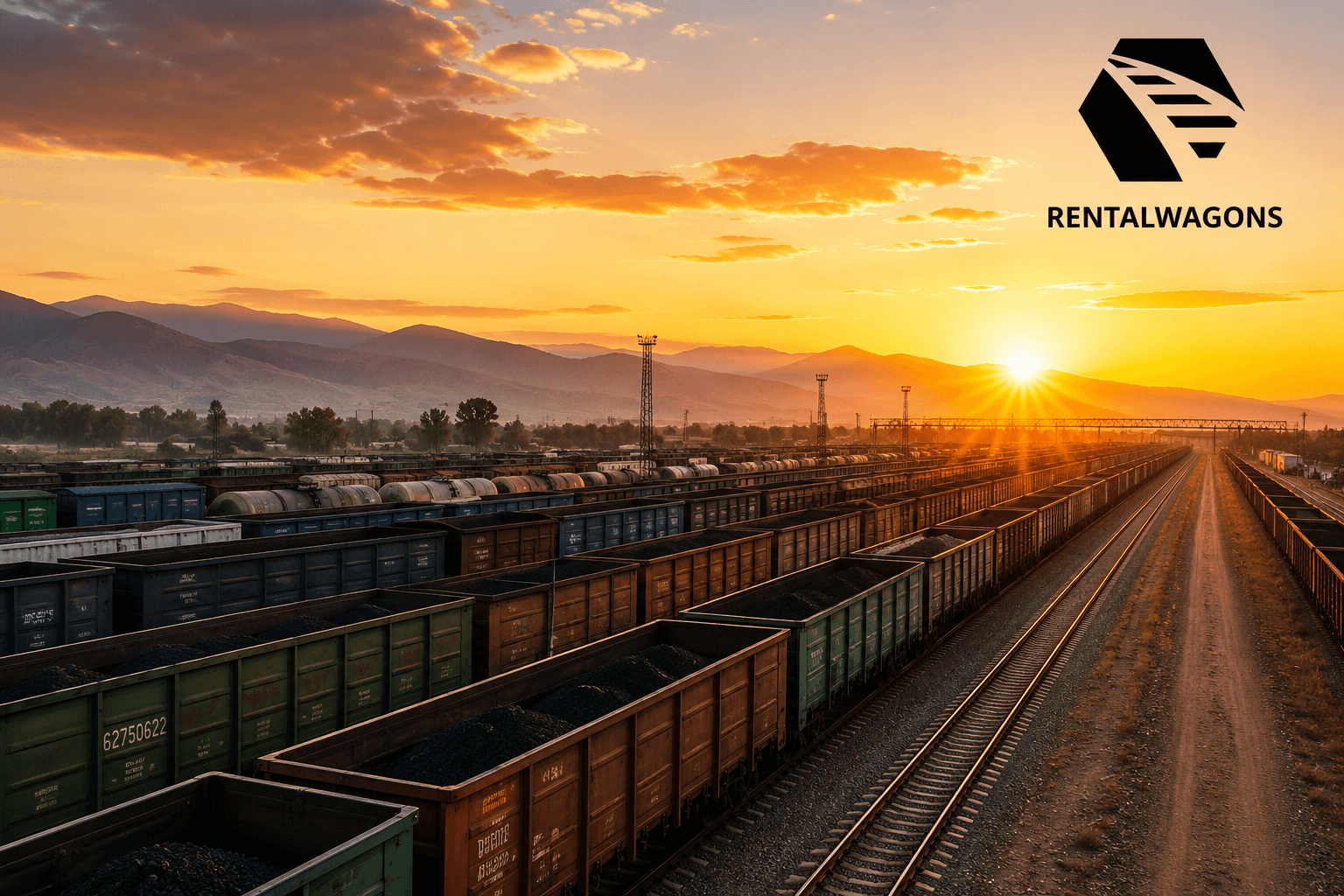
Until recently, Central Asia’s rail freight market appeared to be operating largely on inertia: infrastructure was in place, wagons were available, routes were functioning, but there was no meaningful growth. In 2026, the situation is gradually beginning to change. The market is showing signs of renewed activity, driven primarily by freight flows from China, transit traffic and the restructuring of logistics routes.
Central Asia’s rail freight market is now at an important turning point. On the one hand, the statistics do not yet provide grounds to speak of a full-scale boom. On the other hand, factors that have been missing from the market for some time are beginning to emerge: longer transportation distances, new routes, growing transit demand and increased investment in infrastructure.
For this reason, 2026 can be viewed as a transitional year — from stagnation toward gradual recovery and renewed market activity.
Kazakhstan: Cargo Volumes Are Still Declining, but the Market Is Becoming More Active
Kazakhstan provides a clear illustration of the contradictory trends currently shaping the market.
In January–June 2026, 162.5 million tonnes of cargo were transported by rail in Kazakhstan. This was 1.6% less than during the same period of 2025.
At first glance, this appears to indicate that stagnation is continuing. However, during the same period, freight turnover increased by 4% to 146.7 billion tonne-kilometres.
This is an important signal.
If the physical volume of cargo declines slightly while freight turnover increases, it means that the structure of transportation is changing: cargo is being transported over longer distances, while the role of transit and international routes is growing.
Therefore, the market should not be assessed solely by the number of tonnes transported.
Kazakhstan’s railway system is gradually evolving from a means of transporting raw materials within the country into an important component of the broader Eurasian logistics system.
China Is One of the Main Drivers of Market Activity
One of the key factors behind the current revival is the China direction.
At the beginning of 2026, rail freight between Kazakhstan and China increased by 9.3%, while Kazakhstan’s exports to China grew by 17%.
The development of container transportation is an even more significant indicator.
Routes connecting China’s industrial centres with Central Asia, the Caucasus and Europe pass through Kazakhstan. In the first quarter of 2026, the Trans-Caspian route from Xi’an through Khorgos towards Baku handled 85 rail-and-sea services, an increase of 150% compared with the same period last year.
This is more than just statistical growth.
It represents a change in market behaviour.
Cargo owners are increasingly viewing Central Asia not merely as a transit territory between China and other markets, but as a logistics region in its own right.
Central Asia Is Gradually Becoming a Market, Not Just a Transit Corridor
The situation in Uzbekistan is particularly noteworthy.
In the first quarter of 2026, 28 million tonnes of cargo were transported by rail in Uzbekistan. This was 4.3% more than during the same period of 2025.
At the same time, Uzbekistan’s economy is demonstrating strong activity in transportation and logistics.
During January–June 2026, the value added generated by the transportation and warehousing sector increased by 15.8% in real terms.
This is highly significant for the rail freight market.
When industry, trade and logistics expand, demand also increases for the transportation of raw materials, components, finished products and containerised cargo.
As a result, Uzbekistan’s railway market is now being supported not only by transit traffic but also by domestic economic demand.
New Competition for Freight
Central Asia is gradually moving away from its role as a passive participant in Eurasian logistics.
Kazakhstan continues to hold a leading position thanks to its geographical location, established railway network and border crossings with China.
At the same time, Uzbekistan is actively strengthening its own role in regional logistics.
New routes connecting China with Central Asia are also emerging. In July 2026, FESCO launched a new service connecting several Chinese cities with Kazakhstan and Uzbekistan.
This signals the emergence of new competition for freight flows.
For the wagon market, this is good news.
The development of new routes creates demand not only for locomotives and terminals, but also for rolling stock — gondola cars, covered wagons, platforms and container-handling equipment.
As a result, the revival of transit traffic should eventually translate into stronger demand in the wagon leasing market as well.
The Middle Corridor Is No Longer Just a “Future Project”
Several years ago, the Trans-Caspian International Transport Route — the Middle Corridor — was largely viewed as a promising project for the future.
Today, real volumes are emerging.
According to UNECE, freight volumes transported along the Middle Corridor have increased almost fivefold over the past seven years, from 0.8 million tonnes to 4.5 million tonnes per year.
In 2024 alone, freight volumes along the Trans-Caspian route increased by 62%, reaching 4.5 million tonnes.
In February 2026, the World Bank approved an $846 million guarantee to support the development of Kazakhstan’s railway infrastructure along the Middle Corridor. This is expected to help mobilise an additional $1.41 billion in commercial financing.
For the market, this is much more significant than individual statistical indicators.
Investments of this scale demonstrate that market participants are not betting on a temporary surge, but on long-term growth in freight flows.
Why Is the Market Beginning to Recover Now?
There are several reasons.
First — changing trade geography
China continues to expand trade with Central Asian countries. Kazakhstan and Uzbekistan are becoming important logistics and distribution hubs for Chinese goods.
Second — diversification of transport routes
Cargo owners do not want to depend on a single transportation route.
As a result, interest is growing in alternative land routes through Kazakhstan, the Caspian Sea, the Caucasus and Türkiye.
Third — regional economic growth
Uzbekistan is demonstrating strong growth in industry, trade and transportation and warehousing. This is generating new domestic demand for freight transportation.
Fourth — infrastructure investment
New railway lines, terminals, border crossings and ports are creating conditions for increased capacity and higher freight volumes.
Fifth — containerisation
An increasing share of cargo is being transported in containers. This is changing the traditional structure of the market and creating demand for platforms, container terminals and specialised logistics services.
But It Is Still Too Early to Talk About a Full Recovery
There is another side to the picture.
Kazakhstan’s statistics show that the overall volume of freight transported by rail during the first half of the year is still below last year’s level.
In addition, growing transit traffic continues to face infrastructure constraints involving railway capacity, terminals and ports, border procedures and the need to coordinate operations across several countries.
Therefore, the current market is better described not as a “boom”, but as a “revival.”
This is probably the most accurate description of what is happening.
What Does This Mean for the Wagon Market?
If the current trend continues, the second half of 2026 could become a period of gradual recovery in demand for rolling stock.
This is particularly relevant for wagons operating on international routes.
An interesting situation may emerge in the market: on the one hand, total freight volumes are not growing evenly; on the other, the number of routes, transportation distances and the international component of freight traffic are increasing.
As a result, a wagon may become more valuable not simply because total cargo volumes are rising, but because the wagon spends more time in international circulation.
For wagon owners, this represents an important change.
During the period of stagnation, the main question was:
“Where can we place the wagon?”
As the market begins to revive, the question is gradually changing:
“How can we maximise wagon utilisation and minimise idle time on international routes?”
Central Asia Is Entering a New Logistics Cycle
Today, the region’s rail freight market stands between two different models.
The previous model — in which a significant share of freight flows depended on traditional routes — is gradually giving way to a new system.
In this new model, Kazakhstan is becoming a key transit hub between China and Western markets. Uzbekistan is strengthening its role in regional logistics. Kyrgyzstan is becoming increasingly important as part of emerging routes, while the Caspian Sea is turning into a critical link between Central Asia and the Caucasus.
The statistics do not yet show explosive growth. But they show something else — the market is moving again.
That is why 2026 may not be remembered as the year of a major boom, but as something potentially more important — the year when the market began to emerge from stagnation.
If freight volumes along the new corridors continue to grow, trade between China and Central Asia expands, and infrastructure constraints are gradually reduced, Central Asia could become more than just a territory between major markets.
It could become one of the key logistics hubs of Eurasia.
Railways are becoming one of the clearest indicators of this transformation. For now, growth is measured in percentages. But behind those percentages, a new map of freight flows is already taking shape.